Every Edmonton Rental Listing, Rated: Safety, Walkability, and Rent — Across Every Platform
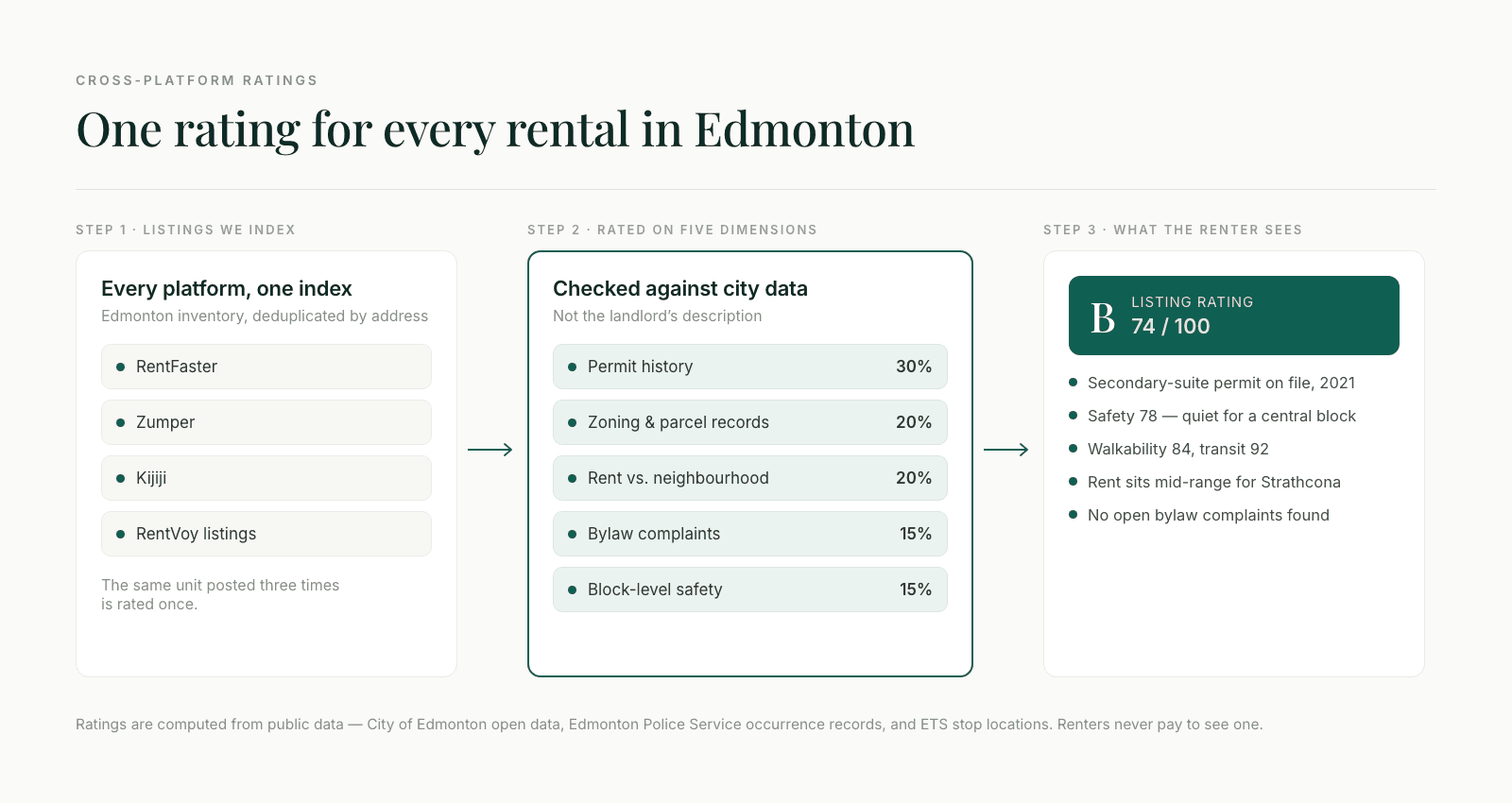
RentVoy now rates rental listings from RentFaster, Zumper, Kijiji, and our own inventory against City of Edmonton open data. One score, five dimensions — block-level safety, walkability, transit, permits, and whether the rent is actually reasonable.
Renting an apartment is the last major financial decision in a person's life that comes with no rating attached.
You would not buy a used car without pulling its history. You would not buy a house without an inspection. You would not book a hotel for one night without reading what the last hundred guests said about it. But you will sign a twelve-month lease worth $18,000 — on the strength of eight photos and a paragraph the landlord wrote about themselves.
That asymmetry is the entire business model of Canadian rental listing sites. They are bulletin boards. They take the landlord's money, publish the landlord's copy, and leave every question of fact to you.
We stopped waiting for them to fix it. RentVoy now rates Edmonton rental listings across platforms — ours, RentFaster's, Zumper's, and Kijiji's — against public City of Edmonton data. Same score, same five dimensions, whichever site the unit was posted on.
Key takeaways
- Edmonton rental listings now carry a rating from 0 to 100 with a letter grade, computed from public records rather than the listing description
- Ratings cross platforms. A unit posted on RentFaster, Zumper, and Kijiji is deduplicated by address and rated once, so you can compare listings that live on different sites
- Five dimensions: permit history (30%), zoning and parcel records (20%), rent against neighbourhood benchmarks (20%), bylaw complaints (15%), and block-level safety (15%)
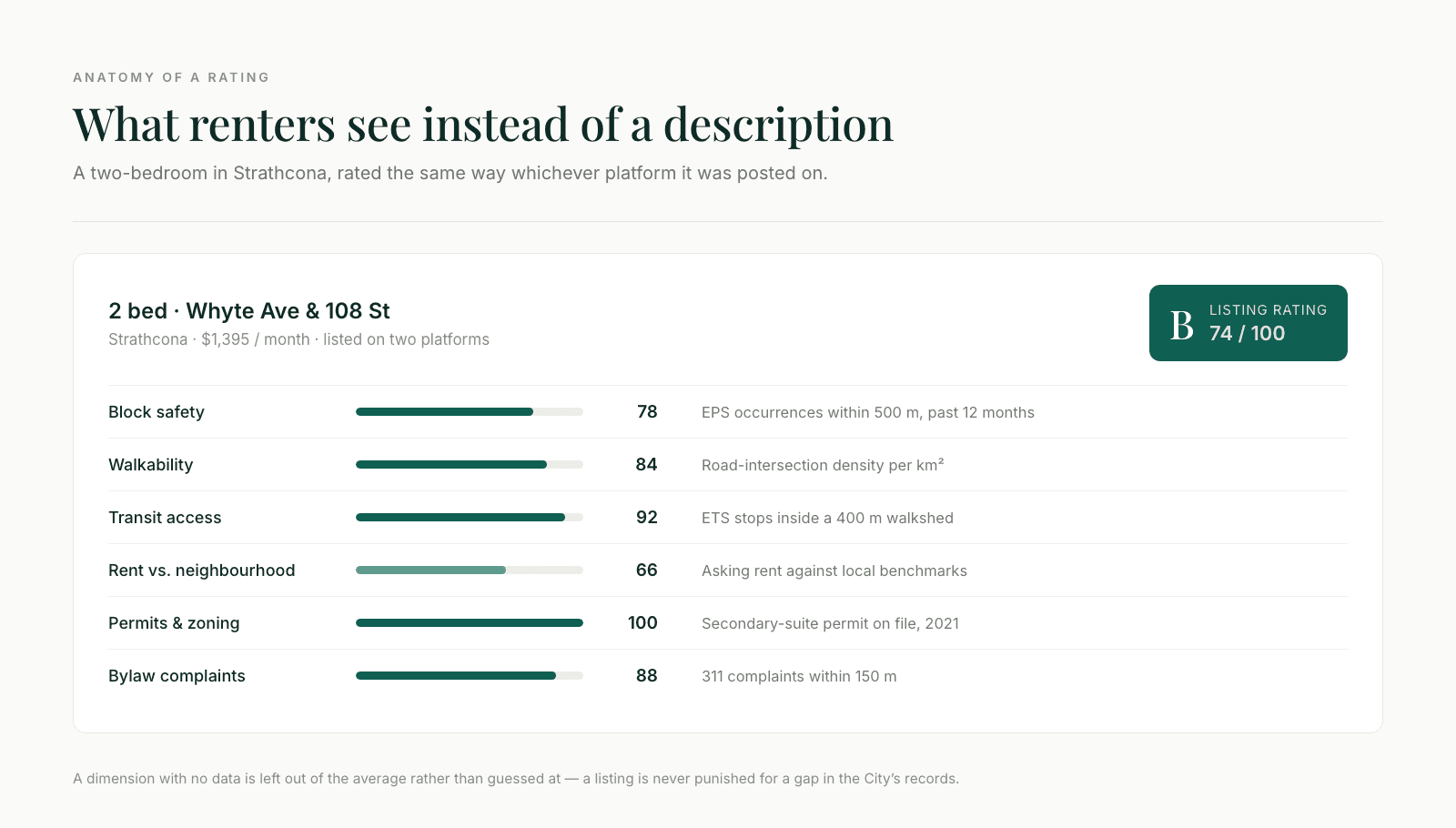
- Safety is measured at the block, not the neighbourhood — Edmonton Police Service occurrence records within 500 m of the actual address, over the previous 12 months
- Walkability and transit are computed, not remembered — road-intersection density per km² and ETS stops inside a 400 m walkshed, across 55 Edmonton neighbourhoods
- A missing dimension is dropped from the average, not guessed at. A listing is never punished for a gap in the City's records
- Renters pay nothing to see a rating. Ever
Why the rental industry earned this
Before the product, the argument. The case for rating listings rests on how badly the current system fails, so here is the evidence.
1. A meaningful share of listings are not real
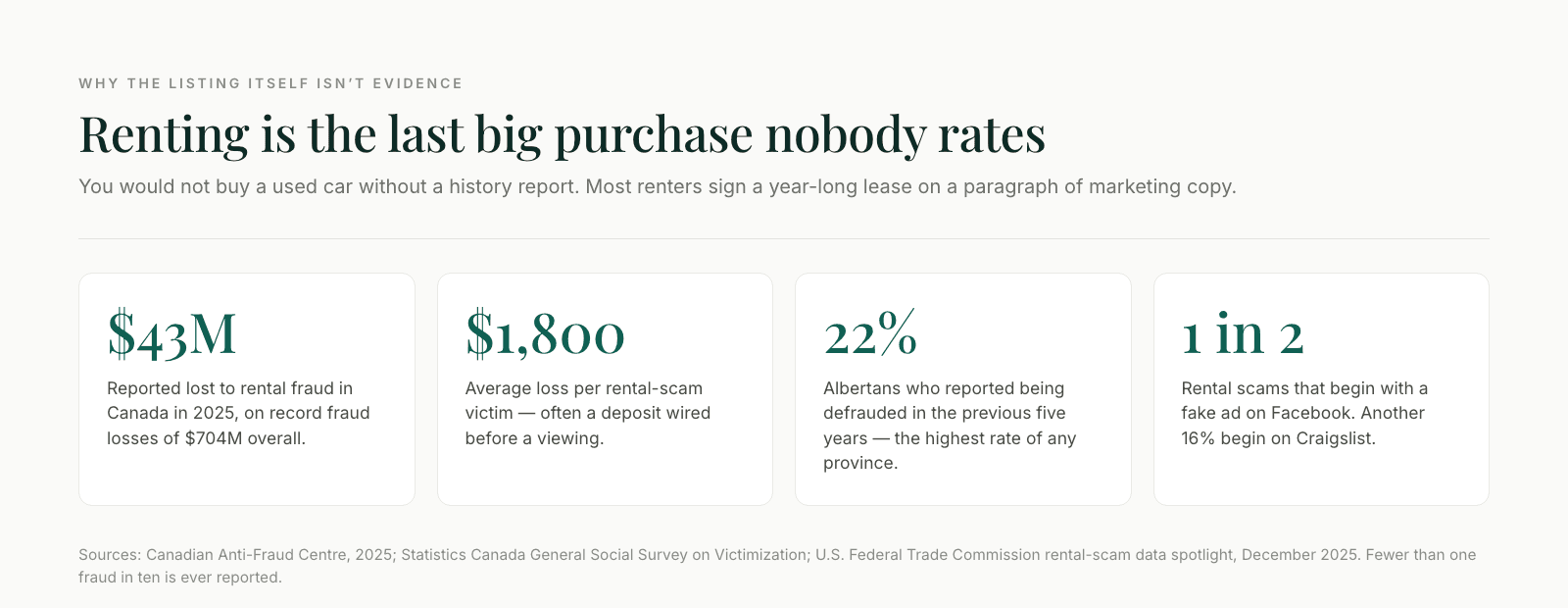
The Canadian Anti-Fraud Centre logged more than $43 million lost to rental fraud in 2025, inside a record $704 million in total reported fraud losses. The average rental-scam victim lost about $1,800 — typically a deposit or first-and-last wired before ever seeing the unit.
Those numbers are floors, not ceilings. The CAFC's own position is that fewer than one fraud in ten is ever reported. And Alberta is not a bystander: Statistics Canada's victimization survey found 22% of Albertans had been defrauded in the previous five years, the highest rate of any province.
South of the border the FTC put a number on where the fake ads live. In the twelve months ending June 2025, about half of reported rental scams started with a fake ad on Facebook, and another 16% started on Craigslist. Renters aged 18 to 29 were three times likelier than other adults to lose money.
The mechanism is boring and effective: copy a real listing's photos and text, repost it somewhere with no identity check, price it slightly under market, and collect deposits from people who never get in the door. We wrote the Edmonton rental scam prevention guide as a manual for spotting this by hand. It should not have to be your job.
2. Ghost listings — real units that rented weeks ago
Not every bad listing is a scam. Many are simply dead.
Listing sites are paid per listing and measured on inventory volume, which means nothing in their incentive structure rewards taking a rented unit down. Some let a landlord "refresh" or "bump" a stale post so it re-enters search results wearing a new date. The unit rented in March; the listing says it was posted yesterday.
You experience this as unanswered inquiries. You send fifteen messages and hear back from four, and you conclude the market is brutal — when in fact a third of what you contacted no longer exists. Our guide to finding an apartment in Edmonton is mostly a set of workarounds for this problem.
3. Bait-and-switch pricing
The advertised unit is the cheapest one in the building, or it is a unit that does not exist. You show up; that one "just went"; here is one $200 more. Sometimes the number in the ad is a promotional rate that assumes a longer lease term, and the actual rent appears only in the lease.
4. Promoted placement dressed up as relevance
On most listing sites the top results are not the best matches — they are the paid ones. "Featured," "premium," "spotlight," and "boosted" all describe the same thing: the landlord paid for rank. A listing's position tells you what a landlord's marketing budget is, not whether the unit is any good.
The comparison of Canadian rental platforms lays out what each site charges for this. It is a legitimate business — it just is not a search result.
5. Fees that appear after you are emotionally committed
Application fees, administration fees, key deposits, "amenity" fees, mandatory parking, mandatory insurance sold through the landlord's preferred broker, and utilities structured so the real monthly cost is 20% above the advertised rent. Alberta caps security deposits at one month's rent, but the ecosystem of adjacent charges is largely unregulated — see the Alberta tenant rights guide for what is and is not allowed.
Our utility costs guide exists because "utilities not included" hides a $150–$300 monthly difference that no listing page shows you.
6. The legality question nobody answers
In Edmonton this one is specific and expensive. A basement suite is either a permitted secondary suite or it is not. An unpermitted suite can be ordered closed mid-lease, may lack legal egress windows, and often has no fire separation. Almost no listing says which it is, and the word "legal" in a description is a claim, not a document.
The City knows the answer. It publishes development permits as open data. Until now, nobody was checking. Our Edmonton basement suite guide runs several thousand words precisely because that burden currently lands on the renter.
None of this requires a villain. It is what you get when every platform is paid by the person writing the description and nobody is paid to check it.
What a rating actually is
A RentVoy rating is a number from 0 to 100 with a letter grade, computed from five weighted dimensions. Every input is a public record. None of it comes from the listing text.
| Dimension | Weight | What it reads |
|---|---|---|
| Permit history | 30% | City of Edmonton development permits at the parcel — including whether a claimed secondary suite has one |
| Zoning & parcel records | 20% | Whether the address sits in a parcel zoned for what is being rented |
| Rent vs. neighbourhood | 20% | Asking rent against benchmarks for that area and unit size |
| Bylaw complaints | 15% | 311 and bylaw complaint history near the address |
| Block-level safety | 15% | EPS occurrence records within 500 m over the previous 12 months |
Grades follow the obvious thresholds: A at 85 and above, B at 70, C at 55, D at 40, F below that.
Two design decisions matter more than the weights.
A missing dimension is removed from the average, not scored zero. If the City has no permit record for a parcel, that dimension's weight is redistributed across the dimensions we do have. A listing is never penalized for a gap in municipal record-keeping — only for what the records actually say.
The reasoning is shown, not just the number. Every rating expands into the specific findings behind it: which permit, what year, how many occurrences, what the neighbourhood benchmark is. A score you cannot audit is just a different kind of marketing copy.
Safety, measured at the block
"Is this a safe area?" is the most-asked and worst-answered question in Edmonton renting. The usual answers are a neighbourhood's reputation from fifteen years ago, or a Reddit thread.
Reputation is a bad instrument because it operates at the wrong resolution. Safety in Edmonton varies enormously within neighbourhoods. A block off 124 Street and a block near a busy LRT platform can sit in the same official neighbourhood and have nothing in common.
So the safety subscore reads Edmonton Police Service occurrence records — the City's Historic_Occurrences_CSDP open dataset — inside a 500 m radius of the listing's actual coordinates, over the previous 12 months, counting crimes against persons and property. Not traffic incidents, not administrative entries.
For calibration, here is roughly what a 12-month count inside that radius looks like across Edmonton:
| Area | Occurrences in 12 months, 500 m radius |
|---|---|
| Glenora | ~44 |
| Tamarack | ~83 |
| Jasper Place | ~301 |
| Downtown core | ~971 |
That spread is the point. A downtown block is not twice Glenora, it is roughly twenty times Glenora — and a single "good neighbourhood / bad neighbourhood" label cannot carry that.
Two honest constraints. Occurrence data is reported crime, which under-counts and varies with reporting behaviour. And density inflates raw counts: a block with 4,000 residents will log more incidents than a block with 400 at identical risk per person. We present the safety subscore as one weighted input among five, next to the count it came from — never as a verdict on a neighbourhood or the people in it.
Walkability and transit, computed rather than claimed
Every listing in Edmonton is "steps to transit" and "walking distance to everything." Those are adjectives. These are measurements.
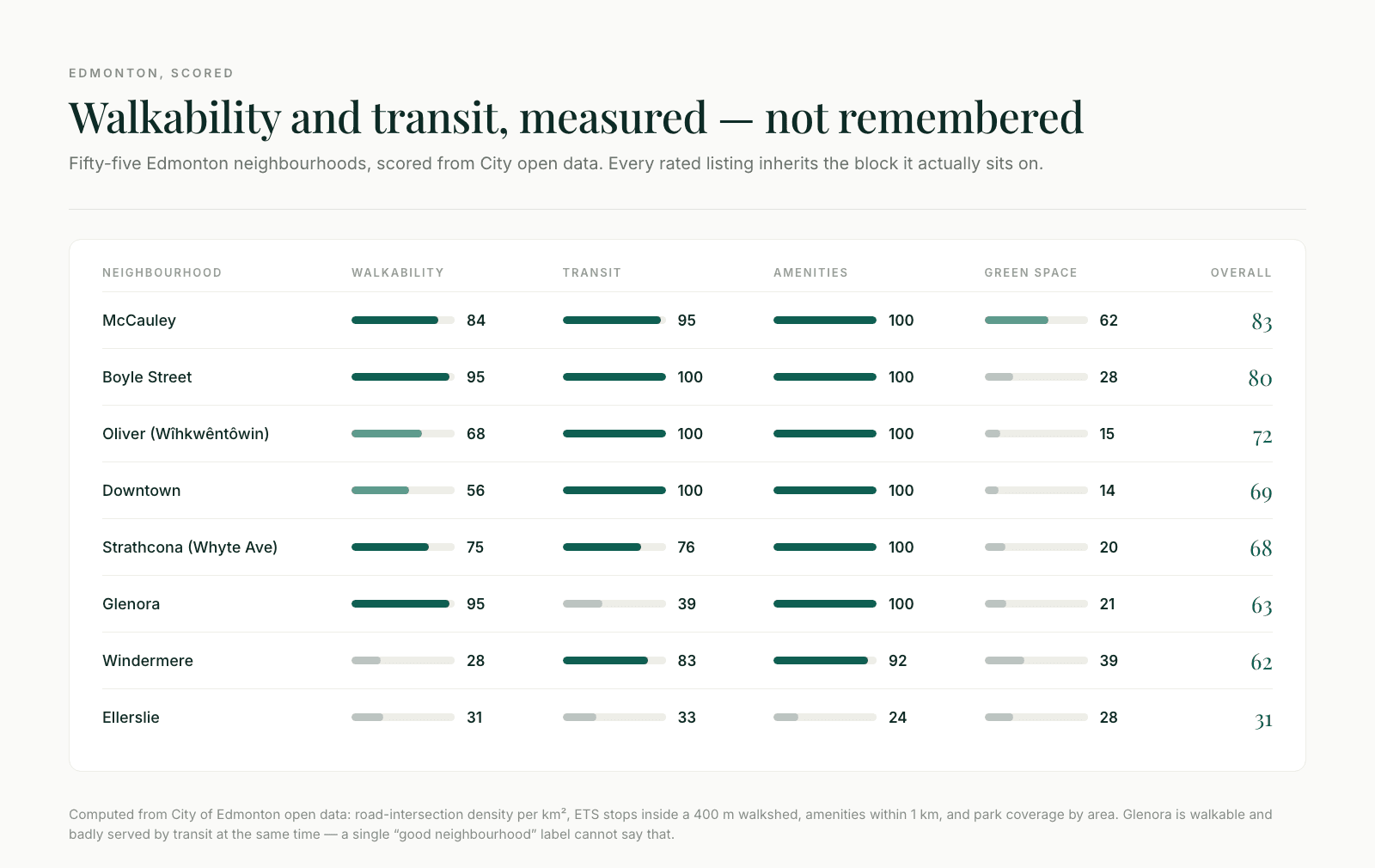
Across 55 Edmonton neighbourhoods we compute four things from City open data:
- Walkability — road-intersection density per km². Intersection density is the core input behind every walk-score methodology, because a dense grid is what makes short trips possible. Edmonton's own intersections dataset includes every junction, so the scale is calibrated locally rather than borrowed.
- Transit — ETS stops inside a 400 m walkshed, which is stops within the neighbourhood plus those within a five-minute walk of its boundary. Measuring the walkshed rather than the polygon stops small neighbourhoods from being penalized for being small.
- Amenities — recreation, schools, parks, and attractions within 1 km.
- Green space — park area as a share of neighbourhood area.
The interesting results are the ones that contradict reputation. Glenora scores 95 for walkability and 39 for transit: a beautiful grid, badly served by buses. Windermere inverts it — 83 transit, 28 walkability, because a new suburb can have frequent service and still be a place where nothing is reachable on foot. Neither is captured by a single "nice neighbourhood" verdict, and if you commute by bus, that difference decides your year.
Every rated listing inherits the scores of the neighbourhood it actually sits in. You can read the full profiles for Strathcona, Oliver (Wîhkwêntôwin), Downtown, Glenora, and the rest on the Edmonton neighbourhoods index — or read the long-form Oliver rental guide and the parking and transportation guide for the context underneath the numbers.
Cost: is this rent actually reasonable?
The rent-vs-neighbourhood dimension answers the question renters ask and no listing site will: is this a fair price, or is this landlord fishing?
The benchmark matters, because Edmonton's market moved. CMHC put the average purpose-built two-bedroom rent at $1,603, with the vacancy rate at 3.8% as of October 2025 and a projected 4.5% by mid-2026 — the loosest this city has been in half a decade. Rentals.ca had Edmonton apartment asking rents at $1,518 in January 2026, up just 0.8% year over year. Downtown one-bedrooms actually fell about 8% year over year, to roughly $1,249.
That combination — record rental construction, softening asking rents, rising vacancy — means asking rents in Edmonton right now range from genuinely good to wildly optimistic, and the listing page cannot tell you which one you are looking at. The rating can. A rent well above the neighbourhood benchmark for that unit size drags the score, and the report says by how much.
The full breakdown by neighbourhood and unit size is in the 2026 Edmonton rental prices analysis and the rental market overview. The short version: in a 4% vacancy market, you have more room to negotiate than the listing wants you to think.
Why it has to work across platforms
A rating that only covered RentVoy listings would be a marketing badge. The point is to be useful on the day you are actually apartment hunting — which means covering the listings you are actually looking at.
So we index rental inventory from RentFaster, Zumper, and Kijiji alongside our own, normalize it, and deduplicate by address. The same unit cross-posted to three sites is one listing with one rating, not three competing impressions of the same apartment.
That produces two things nothing else in this market gives you:
Comparability. A Kijiji listing and a RentFaster listing are rated on identical criteria, so a difference in score is a difference in the unit — not a difference in how much the landlord spent on placement.
Duplicate collapse. The apartment you keep seeing on every site is one apartment. Seeing it once, with a rating, is a materially different search experience than seeing it four times with four different photo sets.
When a listing lives on another platform, we say so and link you there. We are not trying to intercept the click — the platform comparison guide is on this blog because we would rather you find a home than be loyal to us.
What a rating is not
The reference-post rule on this blog is that anything only listing strengths is not worth reading. So:
It is not a safety verdict on a neighbourhood. It is a count of reported occurrences near an address, weighted at 15%, shown with its source. Reported crime under-counts, and density inflates raw counts.
It is not proof a listing is legitimate. A high score means public records line up with the listing. A determined scammer copying a real, well-permitted address will inherit that address's rating. Never send a deposit before seeing a unit in person, whatever the score says — the scam prevention guide covers the rest of the checklist.
It is not a substitute for a viewing. Nothing in municipal open data tells you the building's water pressure, the neighbour's dog, or how loud 109 Street is at 2am.
An absent permit is not proof of anything. City records have gaps, particularly for older conversions. That is why a missing dimension is dropped from the average rather than scored zero.
It is Edmonton-only. The whole model depends on a city that publishes good open data and on our having done the neighbourhood-level work by hand. Calgary is the obvious next city. It is not live.
What this changes on the ground
For a renter, the practical effect is that the first ten minutes of apartment hunting stop being forensic work.
You no longer have to cross-reference a basement suite against the City permit map, guess whether $1,750 is high for a two-bedroom in Strathcona, judge a block's safety from a neighbourhood's reputation, or open the same apartment on four sites to work out it is one apartment.
That work still happens. It happens before you see the listing, on public data, in a way you can audit.
For a landlord with a legal, well-priced, properly permitted unit, the effect is that those facts finally appear somewhere a renter will see them — instead of being flattened into the same paragraph of adjectives as every other listing on the page.
Start here
If you're renting in Edmonton:
- Search rated Edmonton listings
- Browse neighbourhoods by score
- Check your Renter Score — free, no account
- How to find an apartment in Edmonton
- How to spot and avoid rental scams
- What Edmonton rents actually cost in 2026
- Is that basement suite legal?
- Your rights as an Alberta tenant
If you're listing a rental:
Ratings are computed from public data: City of Edmonton open data, Edmonton Police Service occurrence records, and ETS stop locations. Renters never pay to see one. If you think a rating on your listing is wrong, tell us what the records say and we will re-check it — the reasoning is published for exactly that reason.