Average Electricity Bill in Edmonton 2026: Utility Costs by Suite Size for Renters
What the average electricity bill in Edmonton looks like for a bachelor, 1-bedroom, and 2-bedroom apartment in 2026 — plus which utilities EPCOR bills you for, which ones landlords usually cover, and how to compare 'utilities included' against paying separately.

Utility costs in Edmonton are one of those things renters chronically underestimate. Between electricity distribution fees that can double your energy charge, winter gas bills that spike past $200 per month, and a water billing structure unique to EPCOR, what you actually pay each month is rarely what you expected from looking at the energy rate alone.
The average electricity bill in Edmonton for a one-bedroom apartment is about $60 to $85 a month in 2026. A bachelor suite runs $50 to $70 and a two-bedroom $75 to $100, because EPCOR delivery fees often double the energy charge. The suite-size breakdown below shows how those ranges were built.
This guide gives you the real numbers for 2026 — not estimates, but actual rates, average bills, and a clear picture of what to budget for.
Key takeaways:
- Average electricity bill in Edmonton by suite size: bachelor $50–$70, 1-bedroom $60–$85, 2-bedroom $75–$100 per month (gas-heated building, tenant on their own EPCOR account)
- Total utility costs for an Edmonton apartment in 2026 average $150 to $300/month; for a detached home, $380 to $480/month
- EPCOR's Rate of Last Resort for electricity is 12.01 cents/kWh — but distribution and transmission fees often double the total bill
- Natural gas in winter (January) can cost $200–$300 for a detached home; summer gas bills drop to under $55
- Many Edmonton apartment leases include water, gas, or both — search listings with utilities included to see what's typical for your budget
- Internet ranges from $33/month (TekSavvy 30 Mbps) to $115/month (TELUS 5 Gbps fibre)
- Alberta's deregulated energy market means you can shop around for lower rates
How Utility Billing Works in Edmonton
Before looking at specific costs, it helps to understand how Edmonton's utility system is structured. Alberta operates a deregulated energy market, which means you choose your electricity and natural gas retailer. If you don't choose one, you're automatically placed on the default regulated rate.
The key providers for Edmonton renters:
- EPCOR — your default electricity provider and the utility responsible for water, wastewater, and drainage billing in Edmonton
- ATCO Gas — the natural gas distributor for the Edmonton region
- Direct Energy Regulated Services — the default natural gas retailer for ATCO Gas customers who haven't chosen their own
Your utility bill has two main components, and this is where confusion starts:
- Energy charges: The actual electricity or gas you consume (measured in kWh or GJ).
- Delivery charges: Distribution fees, transmission fees, rate riders, and administration charges. These are regulated and appear regardless of which retailer you choose.
As the Move Faster 2026 cost-of-living guide notes, distribution and transmission fees on electricity often double the bill compared to the energy charge alone. A renter seeing an 8-cent/kWh energy rate might expect a $25 electricity bill, but the actual bill comes in at $65–$80 once all fees are added.
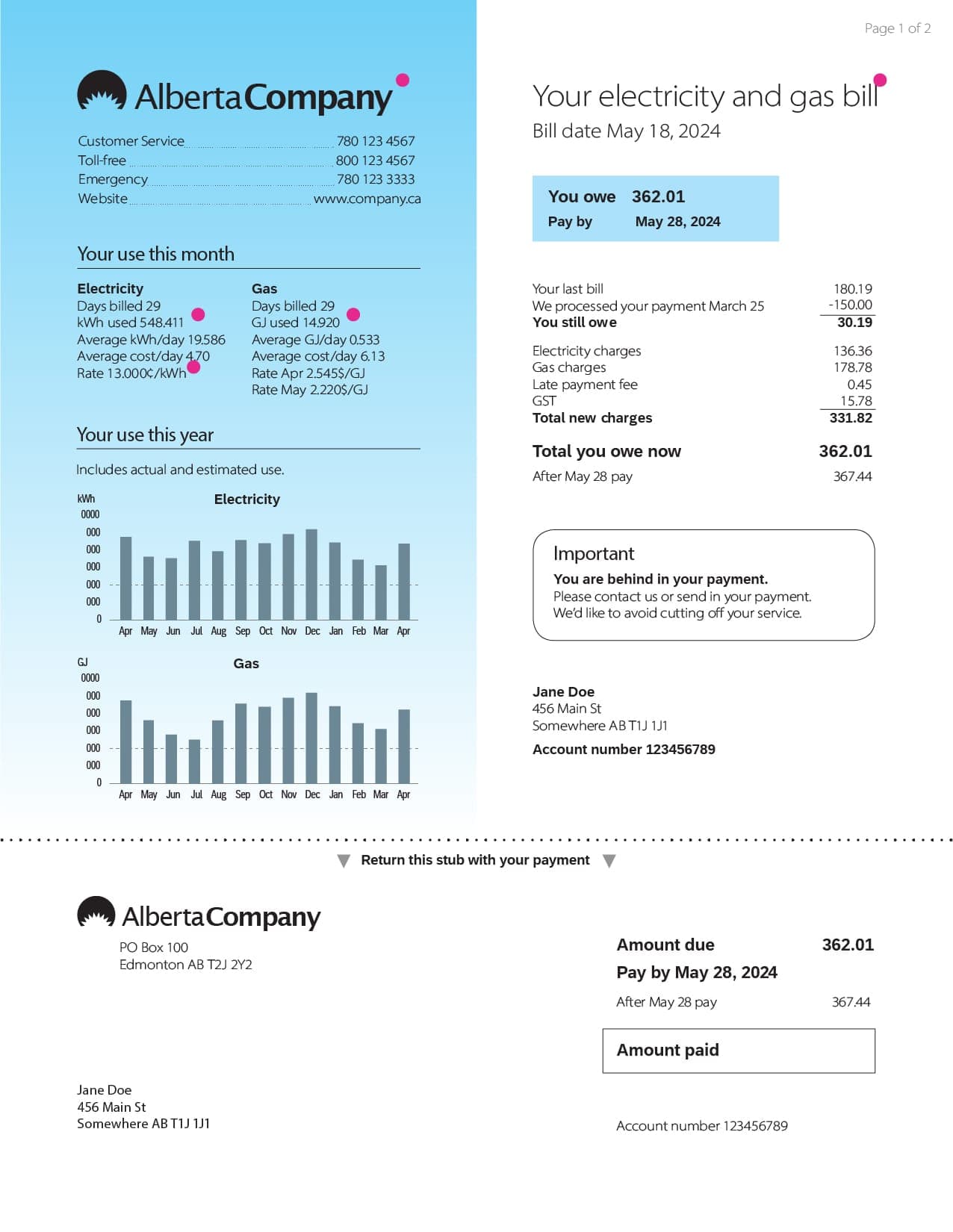
Electricity Costs in 2026
The Rates
If you haven't signed up with a competitive retailer, you're on EPCOR's Rate of Last Resort (RoLR), which is fixed at 12.01 cents per kWh from January 1, 2025 through December 31, 2026, as set by the Alberta Utilities Commission.
However, competitive retailers offer lower rates. EPCOR's own Encor brand currently offers:
| Plan | Rate | Terms |
|---|---|---|
| 2-year fixed | 8.25 cents/kWh | Cancel/change anytime, no penalty |
| 5-year fixed | 10.25 cents/kWh | Cancel/change anytime, no penalty |
| Floating rate | 5.51 cents/kWh (current period) | Changes monthly with market |
Plus a daily administration fee of 32 cents per site on all plans.
The floating rate looks cheap, but it fluctuates monthly and can spike during cold snaps or high-demand periods. For predictability, the 2-year fixed at 8.25 cents/kWh is the most popular option and saves roughly 3.76 cents/kWh compared to the default RoLR.
What You'll Actually Pay
Based on a detailed 2025 Edmonton household utility study posted on Reddit, a two-person household in a semi-detached home using approximately 286 kWh per month paid an average electricity bill of $72.50 per month in 2025 (on a competitive rate plan). Monthly bills ranged from $55 in May to $85 in December.
For an apartment renter using less electricity (no yard lights, smaller space, shared walls reducing heating load), expect $50 to $100 per month for electricity in 2026 depending on suite size. For a house, budget $65 to $100 per month. The next section breaks the apartment figure down by bachelor, one-bedroom, and two-bedroom.
Average Electricity Bill in Edmonton by Suite Size: Bachelor, 1-Bedroom, and 2-Bedroom
The average electricity bill in Edmonton for a one-bedroom apartment is $60 to $85 a month in 2026. A bachelor suite runs $50 to $70, and a two-bedroom $75 to $100. Those figures assume two things that are true of most Edmonton apartment buildings: the tenant holds their own EPCOR (or retailer) account, and the building is heated by natural gas through a central boiler or furnace, so the electricity bill covers lights, appliances, and electronics but not heat.
How the suite-size ranges were built
The 2025 Edmonton case study cited above recorded a 286 kWh month costing $72.50 on a competitive fixed plan. Roughly $30 of that is fixed: the retailer's daily administration fee plus EPCOR's fixed distribution charges, all billed before the first kilowatt-hour. The rest scales with usage at about 15 cents per kWh all in (energy, variable delivery, and GST). Applying that structure to what each suite size typically draws gives the ranges below. Treat them as modelled estimates, not meter readings.
| Suite size | Typical usage | Competitive fixed plan (8.25¢/kWh) | Default Rate of Last Resort (12.01¢/kWh) |
|---|---|---|---|
| Bachelor / studio | 150–250 kWh/month | $50–$70 | $55–$80 |
| 1-bedroom | 200–350 kWh/month | $60–$85 | $65–$95 |
| 2-bedroom | 300–450 kWh/month | $75–$100 | $85–$115 |
What pushes a bill outside its range:
- Electric baseboard heat. Common in older walk-ups and some basement suites, and by far the biggest swing. Expect winter bills to roughly double: a one-bedroom on electric heat can land at $120–$180 in January. Ask how the suite is heated before you ask anything else.
- In-suite laundry and a dishwasher add roughly 30–60 kWh a month, or $5–$10.
- Window air conditioning in July and August adds $15–$30 for the month.
- Occupancy. Two people home all day use noticeably more than one person out at work.
- Rate plan. The gap between the Rate of Last Resort and Encor's 2-year fixed is 3.76 cents/kWh, which is $8–$15 a month for an apartment. Switching is free.
Which utilities EPCOR bills you for, and which the landlord usually pays
EPCOR handles three things in Edmonton: electricity (as the default retailer), water and wastewater, and waste collection. Natural gas is ATCO Gas, with Direct Energy Regulated Services as the default retailer. Here is who typically ends up paying for each in a rental:
| Utility | Who bills it | Typical Edmonton apartment | Typical house or basement suite |
|---|---|---|---|
| Electricity | EPCOR, or the retailer you choose | Tenant, on their own account | Tenant, on their own account (or split if the meter is shared) |
| Heat (natural gas) | ATCO Gas / Direct Energy | Landlord, central boiler, built into rent | Tenant |
| Water, wastewater, drainage | EPCOR | Landlord, one meter for the building | Tenant |
| Waste collection | EPCOR | Landlord | Tenant |
| Internet | Provider of your choice | Tenant | Tenant |
Electricity is usually the one utility an apartment tenant sets up personally. Open the account for your lease start date rather than move-in day, since the suite is in your name from the day the lease begins. In a house or basement suite with a single meter, the utilities stay in one name and get split, most often 60/40 between the upper and lower units.
"Utilities included" vs paying separately: comparing two listings
A listing that says "utilities included" is not automatically the better deal, and one that says it is not automatically worse. Put a number on the difference and compare the totals.
Take two Edmonton one-bedrooms. Listing A is $1,350 with everything included. Listing B is $1,275 with electricity not included. Add the $60–$85 modelled above and Listing B costs $1,335–$1,360, so the two are a wash on price. Listing A wins on predictability, and wins outright if the suite has electric heat. Listing B wins if you are a light user, out most of the day, and happy to switch to a fixed retail rate.
Rules of thumb for a one-bedroom in a gas-heated building:
- "Electricity not included": add about $75 a month.
- "Heat and electricity not included": add $120–$150 a month, more in a poorly insulated building.
- "All utilities separate": add $200–$360 a month, per the summary table below.
Watch for "utilities included" that quietly means heat and water only. It is the most common structure in Edmonton apartment buildings, and it still leaves electricity and internet on you. Get the exact list in the lease.
Ready to compare real numbers? Every RentVoy listing shows which utilities are included, so you can put an all-in figure on each suite before you book a viewing:
- Browse verified Edmonton listings
- Edmonton bachelor suites · 1-bedrooms · 2-bedrooms
- Edmonton rentals with electricity included
Natural Gas Costs in 2026
Natural gas is where Edmonton utility bills get seasonal — and where winter hits your wallet hardest.
The Rates
The default natural gas rate for Edmonton (Direct Energy Regulated Services, distributed by ATCO Gas) changes monthly. According to the Alberta Utilities Consumer Advocate, 2026 rates so far:
| Month | Default Rate ($/GJ) |
|---|---|
| January 2026 | $3.331 |
| February 2026 | $2.422 |
| March 2026 | $1.784 |
| April 2026 | $1.874 |
For comparison, 2025 rates ranged from a low of $0.722/GJ in September to a high of $3.390/GJ in December. Gas is cheapest in summer and most expensive in the dead of winter, when demand peaks.
On top of the commodity rate, ATCO's delivery charges for a low-use residential customer add a fixed charge of $0.997 per day plus a variable charge of $1.049 per GJ, according to ATCO's March 2026 rate schedule. That fixed charge alone adds roughly $30/month before you consume a single gigajoule.
What You'll Actually Pay
From the same Reddit utility case study, a semi-detached home's gas bills in 2025 looked like this:
| Season | Monthly Gas Cost | Monthly Gas Usage |
|---|---|---|
| Winter peak (December–February) | $175–$185 | 13–17 GJ |
| Shoulder months (March–April, October–November) | $70–$135 | 5–11 GJ |
| Summer (May–September) | $45–$55 | 1–2 GJ |
The annual average was $105.83 per month for a home. For an apartment, gas usage is typically much lower — shared walls and smaller square footage reduce heating demand. Many Edmonton apartments include gas (heating) in the rent. If you're paying separately, expect $40 to $80 per month on average, with winter peaks.
Move Faster's 2026 guide estimates heating a detached home in January at -30C at $200 to $300 per month — a figure consistent with the Reddit data.
Water, Wastewater, and Drainage
EPCOR manages water, wastewater, and stormwater drainage for Edmonton. Unlike electricity and gas, there is no competitive market for water — EPCOR is the sole provider.
What You'll Pay
From the Reddit utility study, a two-person home using approximately 4.9 cubic metres of water per month paid an average of $88.75 per month for water, wastewater, and stormwater drainage combined in 2025. Monthly charges ranged from $80 in February to $100 in September (higher in summer due to outdoor water use).
Edmonton Real Estate's 2025 cost-of-living guide puts the range at $100 to $150 per month for water, sewer, and waste collection in a typical home.
A few things to note for renters:
- Stormwater fees are based on lot size, not water usage. Apartment renters generally don't pay stormwater separately — it's built into the building's costs and passed through in rent.
- Many apartment leases include water. Carrington Communities' Edmonton apartment guide notes that most apartment rents include water and waste utilities, with tenants only responsible for electricity or a partial combination.
- If you're renting a house or basement suite, you'll likely be on the hook for the full water bill. Budget $80 to $110 per month for a typical household.
Waste Collection
Edmonton's residential waste collection (garbage, recycling, and organics) is billed through EPCOR as part of the utility bill. The Reddit case study recorded a flat $40 per month for waste collection in 2025, noting a slight reduction thanks to the implementation of Extended Producer Responsibility, which shifts some waste processing costs from consumers to businesses.
Apartment renters typically don't pay waste collection separately — it's included in the building's operating costs and folded into rent.
Internet Service
Internet is the one utility where Edmonton renters have the most choice and the most room to save. PlanHub.ca's April 2026 data counts 17 internet service providers in Edmonton with 110 available plans. The average plan price is $73.59 per month.
Based on NetSpeed Canada's 2026 Edmonton comparison and PlanHub, here are the best value options:
| Provider | Speed | Monthly Cost | Notes |
|---|---|---|---|
| TekSavvy | 30 Mbps | $32.95 | Cheapest no-contract option in Edmonton |
| oxio | 50 Mbps | $49.00 | Best value per PlanHub |
| TekSavvy | 100 Mbps | $48.95 | Editor's Choice (NetSpeed Canada) |
| Moby | 150 Mbps | $45.00 | Alberta fibre provider, select buildings only |
| Moby | 1000 Mbps | $85.00 | Fast fibre, limited availability |
| TELUS PureFibre | 250 Mbps | ~$90.00 | Best fibre coverage across Edmonton |
| TELUS PureFibre | 5 Gbps | $115.00 | Fastest available plan |
For most renters, TekSavvy's 100 Mbps plan at $48.95/month offers the best balance of speed and affordability. It handles streaming, video calls, and working from home without issues. TELUS PureFibre is the premium option if you need top-tier speed and fibre is wired to your building.
Before signing up, check fibre availability at your specific address — older apartment buildings in neighbourhoods like Bonnie Doon, Mill Woods, or McCauley may not have fibre access yet.
Total Monthly Utility Budget: The Summary
Here's what to budget depending on your living situation in Edmonton in 2026:
Apartment Renter (utilities partially included in rent)
| Category | Estimated Monthly Cost |
|---|---|
| Electricity (if paying separately) | $50–$100 (by suite size) |
| Internet | $49–$90 |
| Total out-of-pocket | $100–$190 |
Most Edmonton apartment leases include water, gas/heating, waste, and sometimes even electricity. Your main out-of-pocket costs are typically electricity and internet.
Apartment Renter (all utilities separate)
| Category | Estimated Monthly Cost |
|---|---|
| Electricity | $50–$100 (by suite size) |
| Natural gas | $40–$80 |
| Water/wastewater | $60–$90 |
| Internet | $49–$90 |
| Total | $200–$360 |
House or Basement Suite Renter
| Category | Estimated Monthly Cost |
|---|---|
| Electricity | $65–$100 |
| Natural gas | $45–$185 (seasonal) |
| Water/wastewater/drainage | $80–$110 |
| Waste collection | $40 |
| Internet | $49–$90 |
| Total | $280–$525 |
The Edmonton Real Estate cost-of-living guide estimates total utilities plus internet at $400–$600 for a home, which aligns with these figures when accounting for seasonal variation and larger households.
How to Reduce Your Utility Bills
Switch to a competitive electricity rate
If you haven't actively chosen a plan, you're paying 12.01 cents/kWh on the Rate of Last Resort. Switching to Encor's 2-year fixed at 8.25 cents/kWh is free, has no penalty to cancel, and saves you roughly 30% on the energy portion of your electricity bill. EPCOR's rate comparison page makes this a two-minute process.
Use a programmable thermostat
The Alberta Utilities Consumer Advocate recommends setting your thermostat to lower temperatures when you're sleeping or away, keeping fluctuations under 5 degrees for optimal efficiency. Even a 2-3 degree reduction during the 8 hours you're at work can meaningfully cut your gas bill in winter.
Fix leaks immediately
Leaky taps and running toilets can dramatically increase your water bill. If you rent, report the issue to your landlord immediately — under the Alberta Residential Tenancies Act, landlords are responsible for maintaining plumbing in working order.
Reduce phantom power draw
Devices on standby — chargers, gaming consoles, entertainment systems — draw power continuously. Peace Power recommends using smart power bars that cut standby power when the primary device (TV or computer) is turned off.
Time your appliance use
Use your dishwasher, washer, and dryer during off-peak hours when possible. Opt for cold water wash cycles — they use significantly less energy and clean effectively for most loads.
Take advantage of Alberta rebates and programs
Stay informed about provincial energy efficiency programs. Alberta periodically offers rebates on insulation upgrades, energy-efficient appliances, and smart thermostats. These programs change frequently — check the Alberta Energy Efficiency Alberta website for current offerings.

What to Check Before Signing a Lease
Before committing to any Edmonton rental, ask your landlord or property manager these specific questions:
- Which utilities are included in rent? Get this in writing. Common structures include: all utilities included, water and gas included (tenant pays electricity), or all utilities separate. Search Edmonton listings and filter by included utilities to see what's typical in your price range.
- Are there separate meters? In a house with a basement suite, ask whether utilities are separately metered. If not, understand how costs will be split — the standard Edmonton practice is a 60/40 split (upper floor 60%, basement 40%).
- What energy retailer is the unit currently on? You have the right to switch retailers, but knowing the current setup avoids surprises on your first bill.
- Is the building fibre-connected? If you work from home, this matters. Older buildings may only support cable or DSL, limiting your internet options and potentially costing you more for slower speeds.
Related Resources
- Verified Edmonton rentals — Every listing shows which utilities are included
- Search Edmonton rentals — Filter by utilities included and see what's covered
- RentVoy — Edmonton's verified rental marketplace
- The complete Edmonton moving guide — Utilities setup and address changes
- How to find an apartment in Edmonton — Full renter's guide
Sources
- Reddit — 2025 Edmonton Utilities Usage Case Study: https://www.reddit.com/r/Edmonton/comments/1rmjr1g/my_2025_edmonton_utilities_usage_a_case_study_for/
- Alberta Utilities Consumer Advocate — Default Rates 2025-2026: https://ucahelps.alberta.ca/residential/rates/default-rates/
- EPCOR — Encor Electricity Rate Plans (2026): https://www.epcor.com/ca/en/ab/edmonton/start-services/home/encor-rate-plans.html
- EPCOR — Rate of Last Resort (RoLR): https://www.epcor.com/ca/en/ab/edmonton/start-services/home/rate-of-last-resort.html
- ATCO Gas — North Rate Schedule (March 2026): https://www.atco.com/content/dam/web/for-home/natural-gas/natural-gas-north-rate-schedule.pdf
- Move Faster — Cost of Living in Edmonton 2026: https://movefaster.ca/edmonton-living/cost-of-living-in-edmonton-2026/
- Edmonton Real Estate — Cost of Living in Edmonton 2025: https://www.edmontonrealestate.ca/blog/cost-of-living-in-edmonton.html
- Carrington Communities — Edmonton Apartment Costs Ultimate Guide: https://www.carrington.ca/rentals/blog/post/edmonton-apartment-costs-ultimate-guide
- Alberta Utilities Consumer Advocate — Tips to Save on Utility Bills: https://ucahelps.alberta.ca/learning-hub/tips/tips-to-save-money-on-utility-bills/
- Peace Power — How to Save Money on Utilities in Edmonton: https://faq.peacepower.ca/faq/how-to-save-money-on-your-utilities-in-edmonton/
- NetSpeed Canada — Best Internet Providers Edmonton: https://netspeedcanada.ca/internet-providers-edmonton/
- PlanHub.ca — Best Internet Plans Edmonton (April 2026): https://www.planhub.ca/internet-service-prices-edmonton
- UAConnect — How to Fairly Divide Utility Costs (Edmonton): https://edmonton.uaconnect.ca/en/faq/housing/how-to-properly-search-for-neighbors-or-roommates/how-to-fairly-divide-utility-costs-between-neighbors