Edmonton Rental Market Forecast 2026: What Renters and Landlords Should Expect
Edmonton's rental market is shifting in renters' favour in 2026 as a record wave of purpose-built supply arrives, vacancy rates climb toward 4.5%, and interprovincial migration slows. Here's what the data says and what it means for you.
Edmonton's rental market has entered a new phase. After years of historically low vacancy and relentless rent increases, 2026 is shaping up to be the year the pendulum swings back toward renters. A record construction wave, slowing population growth, and rising incentives are reshaping what it means to rent in the city. Whether you're a renter looking for leverage or a landlord recalibrating your strategy, this is what the data says you should expect.
Key takeaways:
- Edmonton's rental vacancy rate is projected to reach 4.5% in 2026, up from 3.8% in 2025 — the highest it has been in several years
- Average rents are growing modestly at 3%–5%, led by well-located 1–2 bedroom units
- Edmonton saw 21,337 housing starts in 2025, up 16% year-over-year — Alberta hit a 70-year housing construction record
- Free rent incentives (2–6 weeks) are becoming standard in newer purpose-built buildings and expected to persist until 2028
- Alberta gained 65,000 people from other provinces in 2025, but international migration fell as Ottawa cut immigration targets by 20%
- Edmonton's average rent of $1,590/month remains well below the national average of $2,030
Where the Vacancy Rate Is Headed
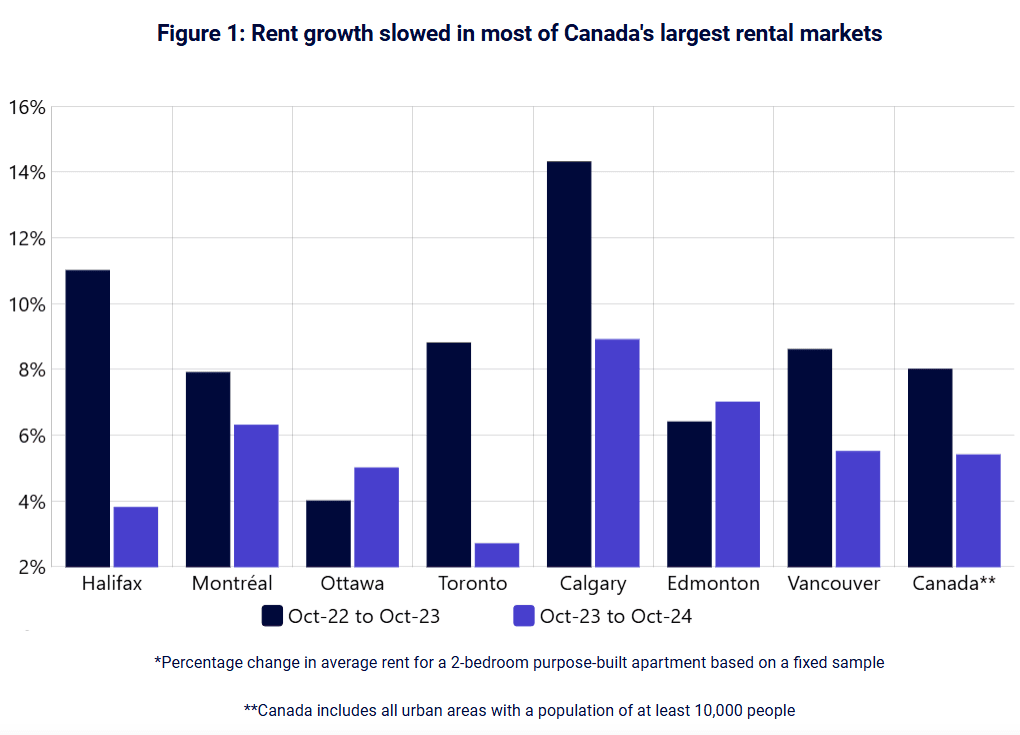
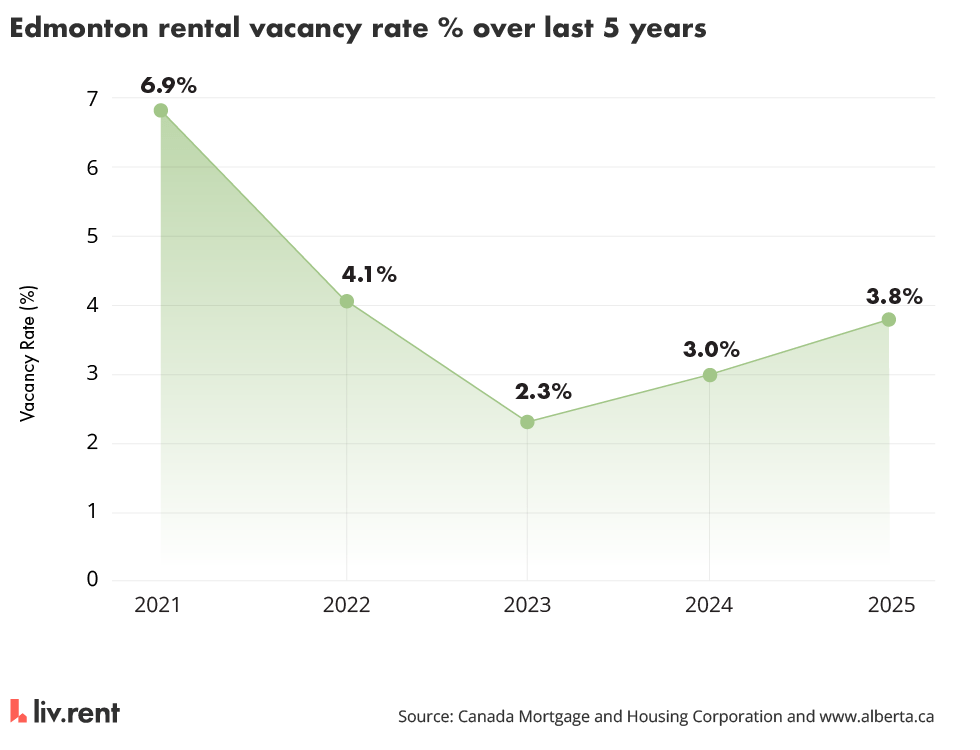
The single biggest story in Edmonton's 2026 rental market is the rising vacancy rate. According to CMHC's 2025 Rental Market Report, the purpose-built rental vacancy rate in Edmonton reached 3.8% in October 2025, up from approximately 3.0% in October 2024. That trend is accelerating: CMHC's chief economist for the Prairies and Territories, Taylor Pardy, projects the rate will climb further to 4.5% in 2026, according to CBC's coverage of the CMHC outlook.
For context, vacancy was hovering near 2% just two years ago — a generational low that sent rents sharply higher. The recovery to a more balanced 4%–5% range historically signals a market where renters can negotiate more effectively and landlords need to compete harder.
It's worth noting that the vacancy picture isn't uniform across the city. The Property Consulting Group's February 2026 analysis notes that central and southwest submarkets remain notably tighter, while newer purpose-built corridors — particularly downtown and along transit nodes — are seeing elevated vacancy as fresh units compete for tenants.
Condo rentals tell a different story: CMHC recorded a vacancy rate of just 1.7% for investor-owned condominiums in 2025, with average two-bedroom condo rents sitting at $1,655 per month. Renters who prioritize modern finishes and premium locations are still facing tight conditions in that segment.

Current Rent Levels: What You're Actually Paying
Edmonton remains among the most affordable major rental markets in Canada. Rentals.ca's January 2026 national rent report, cited in Taproot Edmonton's Q4 2025 economic update, puts the average Edmonton rent at $1,590 per month — significantly below the national average of $2,030.
Breaking it down by unit type, RentYEG's 2026 market guide provides a useful citywide range:
| Unit Type | Citywide Range (2026) |
|---|---|
| Bachelor / Studio | $1,050 – $1,250 |
| 1-Bedroom | $1,250 – $1,550 |
| 2-Bedroom | $1,550 – $1,900 |
| 3-Bedroom | $1,900 – $2,400+ |
CMHC's 2025 data specifically for purpose-built rentals shows average 2-bedroom rents at $1,603, up 3.5% year-over-year. Liv.rent's January 2026 Edmonton housing report records unfurnished one-bedroom apartments averaging $1,246 per month — a slight decline from a year earlier.
Neighborhood Rent Snapshot
Prices vary considerably by location. According to RentYEG's neighborhood-by-neighborhood breakdown:
- Garneau (near the University of Alberta): 1BR $1,450–$1,650; 2BR $1,650–$2,100
- Terwillegar / Southwest: 1BR $1,350–$1,550; 2BR $1,650–$1,900
- Mill Woods: 1BR $1,150–$1,350; 2BR $1,400–$1,650
- Rutherford: 1BR $1,300–$1,500; 2BR $1,550–$1,850
- Ambleside (Windermere): 1BR $1,400–$1,650; 2BR $1,700–$2,100
University-adjacent pockets like Garneau and surrounding streets continue to command a premium, with landlords able to pre-lease 60–90 days in advance due to consistent student and young professional demand, per The Property Consulting Group's 2026 submarket analysis.
The Construction Pipeline: A 70-Year Record
The primary driver behind rising vacancy is straightforward: Edmonton — and Alberta as a whole — built more rental housing in 2025 than at any point in roughly 70 years.
According to CMHC data analyzed in a March 2026 YouTube market breakdown, Alberta recorded nearly 55,000 housing starts in 2025, with seven in ten new projects being multi-unit housing — apartments, purpose-built rentals, and townhomes. Taproot Edmonton's March 2026 report confirms that Edmonton alone saw 21,337 housing starts in 2025, a 16% increase over the previous year, with rental starts hitting record highs.
Several factors drove this surge:
- CMHC's MLI Select program: A federal financing program offering 50-year amortizations and up to 95% loan-to-value ratios for purpose-built affordable rentals. Developers responded aggressively.
- Edmonton zoning reforms: The city liberalized zoning rules, making it significantly easier and faster to build denser residential projects.
- Provincial red tape cuts: Alberta streamlined building codes, reducing timelines for multi-unit approvals.
- Downtown incentives: Edmonton's Downtown Student Housing Incentive (applications now closed, oversubscribed) and the newly proposed Downtown Attainable Housing Incentive — which council voted on in March 2026 and is expected to fund 570–850 units at rents capped at 30% of Edmonton's median renter income — are adding further supply pressure specifically in the core.
Notably, a February 2026 ground-breaking in Mill Woods saw the federal government provide $34 million in low-interest loans to Regency Developments for 130 purpose-built rental units, with all rents required to remain at or below 30% of median household income. That same month, construction started on 183 purpose-built rental homes at the Strathearn LRT site.
The flip side: CMHC and developers alike are already pulling back on new project starts. Taylor Pardy told CBC that builders in 2026 are expected to "scale back and focus on selling off existing inventory before launching new projects." The market analyst community notes that units not started today won't come to market until 2028–2030 — meaning today's construction slowdown sets up potential tightening again in a few years.
Population and Migration: A Shifting Picture
Edmonton's population grew by 3.4% between 2024 and 2025, still high relative to other Canadian cities but a noticeable deceleration from the 2023–2024 pace that drove the rental crunch, according to Taproot Edmonton's Q4 2025 economic update. The city has added over 200,000 residents over the past five years, per liv.rent's 2026 housing trends analysis.
Two migration stories are running simultaneously in 2026:
Interprovincial migration remains strong. Alberta gained approximately 65,000 people from other provinces in 2025 — primarily from Ontario and British Columbia, where housing costs remain dramatically higher. ATB Financial's chief economist Mark Parsons has called Alberta's competitive position "more favourable compared to other regions," and ATB projects 2.7% real GDP growth for Alberta in 2026, revised upward from its December 2025 estimate of 2.1%.
International migration is slowing. Ottawa cut immigration targets by roughly 20% through 2025, and the pace of new arrivals — a major driver of rental demand in 2023 and 2024 — has softened noticeably. CMHC's Pardy cautions that while Prairie-region population growth is declining more slowly than Ontario and BC, the overall moderation does reduce competitive pressure in the rental market. At the same time, he flags a potential "upside risk" if immigrants currently renting decide to transition to homeownership, which would free up rental units faster than expected.
The Oil Price Factor
Edmonton's economy cannot be fully understood without reference to the energy sector. Alberta's 2026 budget, published in February, projects WTI oil at US$60 for the current fiscal year, with private market forecasts ranging from US$52 (U.S. Energy Information Administration) to US$68 (National Bank), according to The Globe and Mail's budget analysis. The province is projecting nearly $9 billion less in non-renewable resource revenue compared to the 2024–25 fiscal year.
For rental market purposes, the practical implication is that while Alberta still benefits from higher oil prices relative to other provinces, the outsized employment boom of 2023–2024 is moderating. Household incomes are growing more slowly, which gives landlords less room to push rents aggressively. However, as ATB's Parsons notes, Alberta entered 2026 having added approximately 85,000 jobs over the prior year, with unemployment at a relatively low 6.7%. The labour market underpinning is solid, even if it's less supercharged than during the peak migration years.
What Renters Should Know and Do Right Now
The data clearly points to this being the best rental negotiating environment Edmonton renters have seen since before 2022. Here's how to take advantage of it:
Look for free-rent incentives. CMHC's Pardy confirmed that 2–6 weeks of free rent is already entering the Edmonton market in newer purpose-built buildings, and he expects these incentives to become standard industry practice until at least 2028. If a new-build landlord isn't offering something, it's worth asking — especially during off-peak leasing months (November through February).
Compare new builds to older stock carefully. The incentives on newer units can make them surprisingly affordable on an effective monthly basis. A unit listed at $1,800 with six weeks free on a 12-month lease actually averages $1,575/month net. Run the math before dismissing a higher asking rent.
Southwest and central submarkets remain tighter. If you're targeting Garneau, Oliver, or southwest Edmonton, expect less leverage than you'd find in newer suburban corridors or downtown high-rise buildings competing to fill out their occupancies.
Negotiate beyond rent. With vacancy rising, parking, storage, pet fees, and lease flexibility are all negotiable — often more so than headline rent, which landlords try to protect for their rent rolls.
What Landlords Should Know and Do Right Now
Vacancy is rising but manageable. A 4%–5% vacancy rate is elevated compared to the 2022–2023 lows, but it's historically within a normal, healthy range. The challenge is concentrated in specific asset classes: brand-new downtown high-rises in lease-up mode, and older buildings competing against incentivized newer product.
Surgical concessions over blanket discounts. The Property Consulting Group's 2026 forecast recommends targeted incentives — free months or parking credits — rather than permanent rent reductions, which are harder to walk back and damage assessed property values.
Pre-leasing windows matter. University-adjacent properties can still lock in leases 60–90 days before the September occupancy cycle. Starting your leasing campaign in June for September move-ins protects your occupancy even in a softer market.
Prepare for the 2028 tightening. Developers are pulling back now. The units not getting started in 2026 will not arrive until 2028–2030. Landlords who maintain their properties and build tenant relationships now will be well-positioned when the next tightening cycle arrives.
The Longer-Term View
Edmonton's rental market has a structural demand floor that distinguishes it from many Canadian cities. The University of Alberta (40,000+ students), MacEwan University, and NAIT collectively anchor a significant, recurring renter population that re-enters the market each September. Alberta's lack of a provincial income tax and lower cost of living compared to Vancouver and Toronto continues to attract interprovincial migrants even as international arrival rates moderate.
The near-term story is one of renters gaining leverage and landlords competing harder. But the longer-term dynamic — a city adding population, relatively constrained land supply in central neighbourhoods, and a construction industry already pulling back — points to the current softening being temporary rather than structural. Edmonton is expected to remain relatively stable, with modest year-over-year rent growth continuing beyond 2026 as population and urban development keep demand solid.
For renters, 2026 is the window to lock in favourable terms or negotiate upgrades. For landlords, it's the time to invest in asset quality and tenant retention rather than banking on rent growth alone.
Sources
- CMHC 2025 Rental Market Report (Edmonton): https://www.cmhc-schl.gc.ca/professionals/housing-markets-data-and-research/market-reports/rental-market-reports-major-centres
- CBC — Edmonton rental market to subside as vacancies rise (February 2026): https://www.cbc.ca/news/canada/edmonton/cmhc-housing-outlook-rentals-alberta-9.7083869
- Taproot Edmonton — Rental housing starts up as more incentives arrive (March 2026): https://edmonton.taproot.news/briefs/2026/03/13/rental-housing-starts-up-as-more-incentives-arrive
- The Property Consulting Group — Edmonton Rental Market and Trends 2026: https://www.thepropertyconsultinggroup.com/about-us/news/edmonton-rental-market-and-trends-2026
- liv.rent — Edmonton Housing Market & Rental Trends 2026: https://liv.rent/blog/rental-laws/edmonton-housing-rental-trends/
- RentYEG — Cost of Renting in Edmonton: 2026 Market Guide: https://rentyeg.com/cost-of-renting-in-edmonton-2026-market-guide/
- CBC — ATB Financial Alberta GDP forecast (March 2026): https://www.cbc.ca/news/canada/edmonton/atb-alberta-oil-gas-economy-forecast-9.7143848
- The Globe and Mail — Alberta Budget 2026 oil price forecast: https://www.theglobeandmail.com/business/article-alberta-budget-2026-oil-prices-energy-forecast-deficit/
- YouTube — Why 45,000 Alberta Purpose-Built Rentals Are Flooding the 2026 Market: https://www.youtube.com/watch?v=VBl9edLSFfQ
- YouTube — 130 federally supported rental apartments coming to Edmonton Mill Woods: https://www.youtube.com/watch?v=RO1kLdDdTzc